The Ghost of the Steppe: The Vanishing Dance of the Asian Houbara
Imagine the vast, windswept plains of Central Asia—a harsh expanse of gravel and sand where the horizon blurs into a shimmer of heat. Out here, where few humans venture, a ghost of the desert performs a ritual as old as the grasslands themselves. A male Asian Houbara, elegant and enigmatic, begins his courtship dance. He runs in a tight circle, his neck coiled into an S-shape, the ornate feathers on his head and neck flaring into a ruff that would make a Victorian nobleman envious. Then comes the sound: a staccato burst of deep, hollow knocks, like a heartbeat echoing across the emptiness. He is invisible to all but the most patient observer, a creature of such cryptic camouflage that even in full display, he seems to melt into the earth.
This is the Asian Houbara, the Macqueen’s Bustard—a bird that has captivated the human imagination for centuries, and one that is now vanishing before our eyes.
A Lifeline of Feathers and Dust
The Asian Houbara is a creature of extremes. It calls home the most unforgiving landscapes on Earth: the arid semi-deserts and steppes that stretch from Egypt’s Nile eastward, across the Sinai Peninsula, through the Levant and the Arabian Peninsula, into the northwestern Indian Subcontinent and the heart of Central Asia, all the way to the Gobi Desert and the Ubsunur Lake Depression. These are places where water is a memory and life clings to the thinnest threads.
The bird itself is a master of survival—an unobtrusive, silent wanderer that most people will never glimpse. It is a partial migrant, a traveler with a complex itinerary that shifts with the seasons. In southwest Asia, it stays put or moves locally, nomadically following scarce resources. But the Central Asian populations are driven by an ancient, restless instinct. In August and October, they lift off from their breeding grounds and head south, arriving at their non-breeding territories between September and November. Their journeys are not mere direct flights; different subpopulations follow different routes, and the young travel alone, without the guidance of adults. It is a harsh apprenticeship for any chick, one that has worked for millennia—until now.
The Weight of a Tradition
To understand the Asian Houbara’s decline, you must understand falconry. For thousands of years, the falconers of the Arabian Peninsula and the Middle East have revered the hunting of this bird. The houbara is not just prey; it is the ultimate test of a falcon’s skill—a fast, elusive bird that twists and dodges across the open plains. To hunt it is to participate in a tradition that stretches back to the Bedouin, a cultural bond between human and raptor that is woven into the fabric of identity.
But tradition has a dark side. By the late 1800s and early 1900s, the Asian Houbara was still relatively common. Yet as the 20th century wore on, something changed. Hunting technology advanced. The falconers arrived in helicopters and four-wheel drives, equipped with satellite trackers and automatic rifles. The quiet, ancient pursuit became an industrialized slaughter. The houbara’s numbers plummeted. By the 1930s, the decline had begun in earnest; by the end of the century, the bird was nearly extirpated across vast stretches of its former range. Overhunting was the primary culprit, but it was not alone. Poaching, habitat destruction, and the relentless encroachment of human activity—especially in the non-breeding grounds—compounded the crisis.
Today, the Asian Houbara is listed as Vulnerable on the IUCN Red List. Many experts believe it should be reclassified as Endangered. The numbers are grim. And the bird itself is so shy, so secretive, that scientists struggle to even count the remaining wild populations. They inhabit remote, inhospitable places, and large-scale releases of captive-bred birds confound any attempt to understand the true state of the wild stock.
The Captive Dilemma
In response to the crisis, a massive conservation experiment has been undertaken: captive-breeding projects. Using artificial insemination, researchers have raised hundreds of thousands of houbaras in captivity and released them into the wild. On the surface, it seems like a heroic effort—a way to replenish the populations decimated by hunting. But there is a troubling undercurrent.
Many falconers see these captive-bred birds as a resource to be used. The releases are sometimes explicitly intended to support hunting, a way to ensure the tradition continues. Even well-meaning conservation programs release large numbers of birds annually. But what does this mean for the wild population? There is growing concern that these captive-bred birds—raised without the knowledge of migration routes, predator avoidance, or natural foraging—could dilute the genetic integrity of the remaining wild houbaras. They may carry diseases, or fail to pass on the essential survival skills that wild birds learn from their parents. In a sense, we are creating a phantom population, a flock that exists but does not truly belong.
The situation is further complicated by the fact that much of what we know about the Asian Houbara comes from these captive birds, not from wild ones. We are studying a shadow, and hoping it tells us something about the substance.
The Ancient Family of Bustards
The Asian Houbara is a member of the bustard family, the Otididae—a group of 27 heavy-bodied birds found across Africa, Asia, Australia, and Europe. They look a bit like cranes or ostriches, but their closest genetic relatives are actually turacos and cuckoos. Bustards are omnivores, preferring insects and small vertebrates when available, but they can survive on plant matter in lean times.
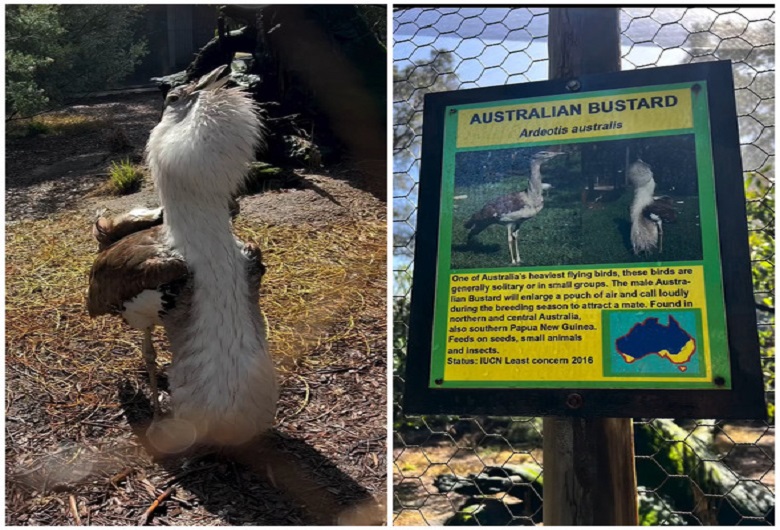
Though they stride across the ground with a deliberate, almost regal gait, bustards are powerful fliers. In fact, the family includes the two heaviest birds capable of flight: the Great Bustard and the Kori Bustard. And then there is the breeding display—bustards perform some of the most extraordinary courtship rituals in the animal kingdom. They gather at leks, where males compete for the attention of females by contorting their bodies, inflating air sacs, twirling, jumping, and running. It is a spectacle that has inspired awe for centuries.
The Great Bustard, the Asian Houbara’s larger cousin, takes this to the extreme. Males can weigh 21 kilograms—45 pounds—making them the heaviest flying birds on Earth. Females, by contrast, weigh a mere 5 to 7 kilograms. This is the most extreme sexual size difference of any bird, a direct consequence of female choice over generations. The females watch and choose the most impressive males, and those males have evolved into giants adorned with striking red plumage, capable of a display that involves contorting their bodies and inflating a specialized throat sac. It is a dance of life, performed at traditional lek sites each spring.
But the Great Bustard has also suffered. Severe declines over the past century mean that few people now witness this dance. The Asian subspecies, found only in Mongolia, China, and southern Siberia, is of particular concern. In Mongolia, the population is estimated at fewer than 2,500 birds. As the country transitions to a free-market economy, new threats emerge: roads cut through the steppe, natural resource development scars the landscape, and land privatization fragments the habitat. The nests, simple scrapes in the ground, are destroyed by agricultural machinery. The insects that chicks depend on are killed by pesticides. Power lines—those invisible killers—claim heavy-bodied bustards that cannot maneuver quickly enough to avoid them. And despite legal protections, hunting continues.
The Little Bustard and a Wider Loss
The bustard family is facing a global crisis. The Little Bustard, a species weighing less than a kilogram, once bred across western Europe and Kazakhstan. It preferred low-intensity agricultural habitats—fields with fallow rotations, pastures used for livestock. But agricultural intensification has been devastating. Irrigation, overgrazing, and machinery that crushes eggs have driven the Little Bustard into steep decline. Its males, with their attractive black collars, gather at leks to stamp, click, and make small jumps. It is a charming performance, one that may soon become a memory.
Why should we care about a bird few of us will ever see? Because the bustard is a sentinel. Its decline signals the unraveling of entire ecosystems—the dry grasslands, the steppes, the semi-deserts that are home to countless other species. The loss of the Asian Houbara is not just the loss of a bird; it is the loss of a way of life, a thread in the fabric of human culture that stretches back to antiquity.
A Quiet Hope
Despite the grim picture, there are people who refuse to give up. Researchers brave the harsh landscapes of Central Asia, tracking wild houbaras with radio transmitters, trying to understand their movements and needs. They work with local communities and conservation agencies to quantify risks and develop plans. They communicate the value of these birds to people who may have never seen one, but whose actions affect their fate.
The Asian Houbara is a ghost of the steppe, but it is not yet a ghost. It still dances, still migrates, still raises its young in the dust and the wind. Whether it will continue to do so depends on us—on whether we can find a way to balance tradition with survival, to protect the wild even as we try to restore it. The houbara asks for nothing but the space to exist, to continue its ancient, silent journey across the world’s most beautiful, most barren places. That is not too much to ask. But it is everything.